The Vikings Or Colombus Might Not Have Been The First Ones To Discover America

Most people, including me, have held Christopher Colombus responsible for the discovery of America, until I read about these ancient Roman coins. However,. I still respect Christopher Colombus for his bravery and hard work in crossing those great seas to behold this great land, America. Still, discovering this article made me feel like I just discovered a about aliens hidden by the government.

Roman coins have been dug up in America, suggesting that they might have been here before the Vikings or Christopher Colombus.

In 1963, a construction engineer found a small hoard of coins while excavating the north bank of the Ohio River during construction of the Sherman Minton Bridge for Interstate Highway 64 at the Falls of the Ohio, from New Albany, Ind., to Louisville, Ky. The coins were grouped as though they had originally been in a leather pouch that had long since disintegrated.

The discover kept most of the hoard for himself, but gave two of the coins to another engineer on the project. In 1997, the second engineer’s widow brought these two to Troy McCormick, then manager of the new Falls of the Ohio Museum in Clarksville, Ind., not far from the find site. She donated them to the museum, where they remain today.

McCormick identified the smaller coin from a guide to Roman coins as a bronze of Claudius II, from 268 A.D. The larger coin has been identified by both Mark Lehman, president of Ancient Coins for Education, Inc., and Rev. Stephen A. Knapp, Senior Pastor at St. John Lutheran Church, Forest Park, IL, and a specialist in late Roman bronze coinage, as a follis of Maximinus II, from 312 or 313 A.D., despite McCormick’s original identification of the coin as a 235 A.D. bronze of Maximinus I.

The coin of Claudius II is similar in type and period to the recently discovered Roman coins from Breathitt Co., Ky., but is in a much better state of preservation. The later coin makes this find several decades later than the Severian Period (193 – 235 A.D.) to which the Roman Head from Calixtlahuaca, Mexico has been attributed on stylistic grounds.

Unfortunately, the discoverer moved south to work on another bridge shortly after the find, and the second engineer’s widow could not remember his name, so the bulk of the hoard is lost.

For several years, the Falls of the Ohio Museum had an exhibit about the find that displayed several casts of both sides of the two originals, so as to reflect the approximate number of coins originally in the hoard. The two original coins, depicted above, are in storage and were not on public display. I have recently (2/12) been informed that the replicas are still on display, despite an earlier report to the contrary, in the Interpretive Center as part of the Myths and Legends exhibit, and will remain there at least into 2014.

The hoard is not included in Epstein’s 1980 survey of coin finds in the U.S.

McCormick is currently President and owner of Natural Concepts, a museum and exhibit consulting firm. The author is grateful to him for providing this information and the above images.
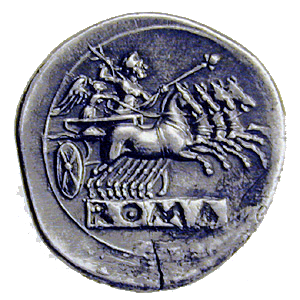
An ancient roman coin.

The Amazing Rarity Of Peace In The Ancient Civilized World

Calculatedly, in the past 3500 years, we’ve had only 230 years of peace in the civilized world.

Below are a three of the wars, their causes and their ends:

The Cimbrian War (113–101 BC) was fought between the Roman Republic and the Germanic tribes of the Cimbri and the Teutones, who migrated from the Jutland peninsula into Roman controlled territory, and clashed with Rome and her allies. Just as Marius was coming to power as Consul in 107 BC, a major migration by Germanic (perhaps Celtic) Cimbri was causing consternation along Rome’s northern frontier. Apparently under threat of starvation from poor harvests and from external threats by other tribes, the Cimbri were on the move looking for new, more promising land. By 113 BC, the Germanics made their first appearance in Roman written history. These movements, and associated great losses in the Roman army stood as the main reason for Marius’ military reforms, and not some great advocacy for the plebes, as the people of the time generally believed. Marius defeated the Cimbri at Vercellae. His campaigns against the Germanic invaders, which seriously threaten Rome’s existence, led to the creation of a professional standing army at Rome.

The final war of the Roman Republic, also known as Antony’s civil war or the war between Antony and Octavian, was the last of the Roman civil wars of the republic, fought between Cleopatra (assisted by Mark Antony) and Octavian. After the Roman Senate declared war on the Egyptian queen Cleopatra, Antony, her lover and ally, betrayed the Roman government and joined the war on Cleopatra’s side. After the decisive victory for Octavian at the Battle of Actium, Cleopatra and Antony withdrew to Alexandria, where Octavian besieged the city until both Antony and Cleopatra died by suicide.

Following the end of the war, Octavian brought peace to the Roman state that had been plagued by a century of civil wars. Octavian became the most powerful man in the Roman world and the Senate bestowed upon him the name of Augustus in 27 BC. Octavian, now Augustus, would be the first Roman Emperor and would transform the oligarchic/democraticRepublic into the autocratic Roman Empire.

The last Republican Civil War would mark the beginning of the Pax Romana, which remains the longest period of peace and stability that Europe has seen in recorded history.

The Second Goryeo-Khitan War was an 11th-century conflict between the kingdom of Goryeo and the Liao dynasty (the Khitan Empire) near what is now the border between China and North Korea. It was the second of the Goryeo-Khitan Wars, with the First Goryeo-Khitan Waroccurring in 993, the second in 1010, and the third in 1018.

When King Seongjong died in 997, Liao invested his successor Wang Song as king of Goryeo (King Mokjong, r. 997-1009). In 1009, he was assassinated by the forces of the general Gang Jo. Using it as a pretext, the Liao attacked Goryeo in the next year. They lost the first battle but won the second one, and Gang Jo was captured and killed. Liao occupied and burnt the Goryeo capital Kaesong, and withdrew after Goryeo reaffirmed its tributary relationship with Liao.

Doctors Paying Patients in Ancient China

In ancient China, doctors just had to get that sickness cures, because if they didn’t they wouldnt get paid… They’d be the ones to pay!

Chinese Medicine covers roughly 3,000 years of history (about 2,000 years of written history) and is a medicine that has been practiced widely and sometimes exclusively in countries like the People’s Republic of China, Taiwan, South and North Korea, Japan, Vietnam and Hong Kong. It developed independently of Western medicine for thousands of years and was responsible for treating every disease that was.

Li Shizhen

Li Shizhen, courtesy name Dongbi, was one of the greatest Chinese physicians, polymaths, scientists, herbalists and acupuncturists in history.

Li Shizhen was born in Waxiaopa, a small village just north of Qizhou on the Yellow River in what was northern Huguang and is today Hubei Province (see maps, Figure 8, 9).  He was born in 1518 A.D., at the height of the Ming Dynasty (1368-1644 A.D.), which was a time when Neo-Confucianism gained many adherents.  This doctrine emphasized the importance of personal behavior, morality, self-cultivation, study, meditation, and careful thought, while it downplayed the value of crafts and technology, including the practice of medicine.  Neo-Confucianism was to have a significant influence on Li Shizhen’s life.

Li Shizhen’s father, Li Yenwen, had decided to make a better life and became a traditional style (Confucian) physician and scholar.  He was successful at this and attained the rank of a subordinate medical officer of the Imperial Medical Academy.  He was widely respected by his peers.  Li Yenwen is still known to this day for writing the first monograph on ginseng; he also wrote books on the four diagnostic techniques, on smallpox, on pulse diagnosis, and on the local artemisia (used for making moxa) of Hubei.   Despite his accomplishments, those involved with practicing medicine were deemed to be residing low on the social scale even when among the scholarly class.  Li Shizhen, who showed intelligence early on, was encouraged by his father to study the classics, take the imperial examinations, and aim for a government post as a non-medical scholar, the highest attainment possible for someone born outside Imperial circles.  Little is known of Li Shizhen’s brother and sister, both of whom may have led ordinary lives.

The historical roots of Chinese Medicine are in shamanism and a naturalistic view of the universe. It was later influenced by Taoism and Buddhism but a fundamental tenet of Chinese Medicine is that man is a part of the nature. The microcosm of a person’s health is reflective of the macrocosm of nature and the universe. Thus, in Chinese Medicine we are always concerned how the environment affects our health.

So what is Chinese Medicine? It is a comprehensive system of medicine that has developed independently of Western medicine for over three thousand years. It is only in the past three hundred years that Chinese Medicine has been influenced by Western medicine. The five arms of Chinese Medicine are: acupuncture (including surgery, although this is not in practice today), herbal medicine, massage and bone setting, martial and meditative arts (Gong Fu, Chi Gong, Tai Qi) dietary therapy

Among the 5 arms of medicine, dietary therapy is considered the highest form of medicine. We do not know why dietary therapy is thought of so favorably but we think that if a doctor can cure disease through nutritional counseling, the patient gains the ability to cure their own disease and maintain health.

Another important notion of Chinese Medicine is the prevention of disease and maintenance of health. Historically, a Chinese Medicine doctor was paid a retainer to keep their patients healthy. If a patient became sick, the doctor would not be paid until the patient’s health returned. In a similar vein, a doctor that resorted to surgery was considered an inferior doctor. If he/she did their job well and helped their clients stay healthy, there would be no need to perform surgery.

In this modern age, the style of Chinese Medicine that is most prevalent in the United States is based on the medical model of the People’s Republic of China. This approach to medicine is usually termed Traditional Chinese Medicine, or TCM for short.

In China, hospitals include both a Western medicine and Chinese medicine ward. Upon admittance, the staff directs the patient to the appropriate area. It is not uncommon for both modalities of medicine to be administered for a patient. For instance, acupuncture anesthesia may be performed during a surgical procedure. Post-surgery, acupuncture and herbs are administered to speed recovery.

“… unbearable period pains due to Polycystic Ovarian Syndrome… my response to the treatment was nearly instant and results unbelievable.”

– Ivana, San Francisco

The unbelievable reason for golf’s name

Golf_ball_resting_near_fairway_wood

Golf, a widely loved and very famous game, has a very, very hard to believe reason for being named golf.

In 1927, golf was invented, and was named ‘golf’, meaning:’gentlemen only ladies forbidden’. It’s amazing how ironic this name is once you read about the Royal and Ancient golf club. This club seeks to do away with gender discrimination by letting women play. Yet, Peter Dawson – whose job makes him both arbiter of the rules of the game and also responsible for the British Open – seemed scornful of the idea that his club should let women in. He explained to the Telegraph, sometimes men needed to be with men. In 2013’s row over the Open going to Muirfield, another one of the men-only golf clubs in the SNP Utopia of fairness and justice, Dawson also dismissed the idea that men-only clubs should be banned from hosting the UK’s biggest and oldest professional golfing championship. However, he has recently changed his mind enough at least to allow a vote on admitting women at his own club.

Today, men and women are notionally equal, but there is still room for reform. The feminist movement has opposed sex discrimination, fought to ensure greater participation by women in the new parliament, and had some success heightening awareness about violence against women. Still, many young men and women consider it acceptable to hit a woman or force her to have sex in certain circumstances. Women, especially as single parents and pensioners, are more vulnerable to poverty than men are, and the vast majority of single parents with dependent children are women.

Although you won’t see women playing in this week’s U.S. Open, technically the championship is open to both men and women with additional provisions for transgender golfers. In spite of this, however, the entry form assumes male golfers by its very language: “By his application, the player acknowledges that he is not entitled to remuneration of any kind for participation in the Championship.”

The reason this technically “gender-neutral” major championship has male golfers only is that the U.S. Open application requires a USGA Handicap Index® of 1.4 or lower. (That’s like shooting par on every hole from the longest tees.) More importantly, the Handicap Index of the applicant must be based on course ratings for male golfers!

Accordingly, if a top female golfer wants to qualify to play in the Open, she must post her scores for handicap purposes as if she was a male player. She must use the course ratings for male golfers from tees rated for male golfers, which are usually about 1,000 yards longer than tournament tees for professional women golfers.

Although there are many female recreational golfers that play better than recreational male golfers, at the very top of today’s professional golf pyramid most female pros probably would not qualify for this week’s men’s U.S. Open. That’s the reason you won’t see women on the fairways at Merion next weekend and why the tournament is really just for men.

In the way of background: In 2003, Annika Sorenstam became the first modern-era female to play in a men’s PGA Tour event. She received a sponsors’ invitation to play in the Colonial Tournament in Fort Worth. She was at the top of her game. It was a highly publicized and historic event. But the Swede did not make the cut for the final rounds. Playing from the men’s tees, she just did not have the length to play better than her male counterparts.

Sorenstam’s golf attire from the Colonial now sits on display at the World Golf Hall of Fame Museum in St. Augustine, Fla., but she never again sought out head-to-head competition against men in a professional tournament. Instead, she is a driving force in promoting the success of the LPGA while pursuing golf course architecture and her golf instruction academy.